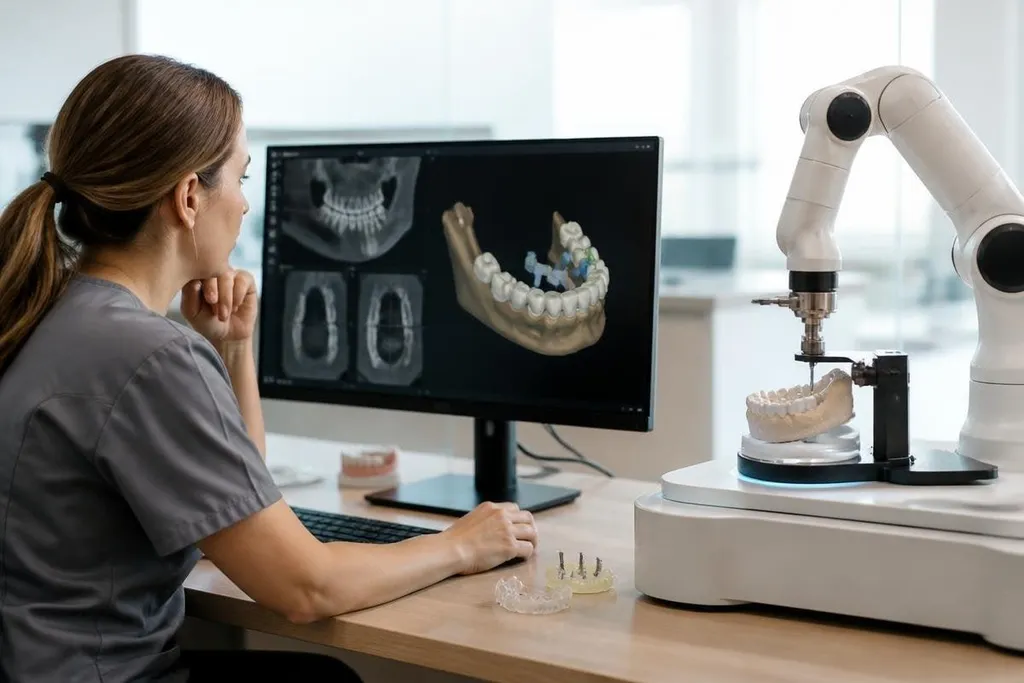
Dental robotics now links digital treatment planning with machines that guide, hold, or perform parts of a procedure. The useful question is not how human the robot looks, but which step it handles with better control.
- 3D planning turns scans into a map for implant and oral surgery work.
- Guided drilling keeps the tool on a planned path and limits unwanted movement.
- Lab robots cut, print, mill, or move dental parts outside the patient’s mouth.
Planning before the robot moves
The first major change happens before treatment starts. A dentist can combine cone-beam computed tomography, known as CBCT, with an optical scan of the teeth.
The result is a three-dimensional plan that shows bone, tooth surfaces, and the planned position of an implant. That plan gives the robot a fixed target and gives the dentist something to check before a drill touches bone.
The robot still depends on the scan, the registration between scan and patient, and the dentist’s treatment plan. A bad plan can be followed with great accuracy.
This is where software matters most. It can set the angle, depth, and entry point for drilling, then send those limits to the robotic system. The machine handles movement; the dentist remains responsible for diagnosis and treatment choices.
Guided drilling and implant placement
Robotic dental systems can guide a drill along a planned path during implant surgery. Some systems hold the handpiece or control its movement. Others give the dentist physical guidance, alarms, or limits when the tool moves away from the plan.
The practical gain is repeatable motion. A dentist may need to keep the drill away from nearby roots, nerves, or thin bone. A robotic guide can reduce hand movement around that path, but it cannot make the bone thicker or remove the need for careful imaging.
The hard part is keeping the plan matched to the patient. The head must stay still, the tracking markers must remain visible, and the system must know where the patient sits in relation to the scan. A small registration error can matter more than a smooth robotic arm.
That registration step gives dental robotics reporting a clear test: did the robot follow a checked plan, and who stepped in when the patient moved? Robot24 can place the scan, tracking method, procedure, and human checks beside the machine’s result. The same standard matters when robots work outside the treatment room.
Robots outside the treatment room
Dental laboratories already depend on digital files, computer-controlled milling, and 3D printing. Robotics adds movement and handling to that process. A system can load materials, move parts between machines, inspect surfaces, or repeat a tool path across many orders.
This work changes the dentist’s experience indirectly. A more repeatable lab process can make crowns, bridges, aligners, and surgical guides easier to produce from digital designs. The result still depends on the material, the design file, the machine settings, and the checks performed after production.
Lab robotics also has a clearer boundary than surgery. The robot works on a part outside the body, where a failed cut can be rejected and remade. That makes lab automation an easier place to test repeatable machine work before using robots near a patient.
What remains unproven
Dental robotics has a narrow job description. It can guide motion, keep a tool near a planned path, and repeat digital production steps. It does not replace a dentist’s examination, patient communication, or judgment when the tissue differs from the scan.
The evidence question matters too. A demonstration can show a robot completing a planned movement. It does not, on its own, show better healing, fewer complications, lower treatment cost, or better long-term results.
I’d rank patient outcomes above smooth motion when judging a dental robot. A system needs clinical evidence, clear safety limits, training needs, service terms, and a price that fits the practice.
A practical check before buying
Use this checklist when a supplier presents a dental robot:
- Name the step: Ask which exact part of treatment the robot handles.
- Check the input: Confirm the scan types, tracking tools, and files the system accepts.
- Test the limit: Ask what happens when the patient moves or the tracking signal drops.
- Read the evidence: Separate lab tests, clinical studies, and sales demonstrations.
- Price the whole setup: Include software, training, service, consumables, and downtime.
- Set the human role: Write down which decisions stay with the dentist.
The next useful proof will come from systems that connect planned motion with patient results over time. Until those records are available, the soundest dental robot is the one that makes one defined step safer to check, easier to repeat, and clear to stop.